Image ChatGPT Image 2
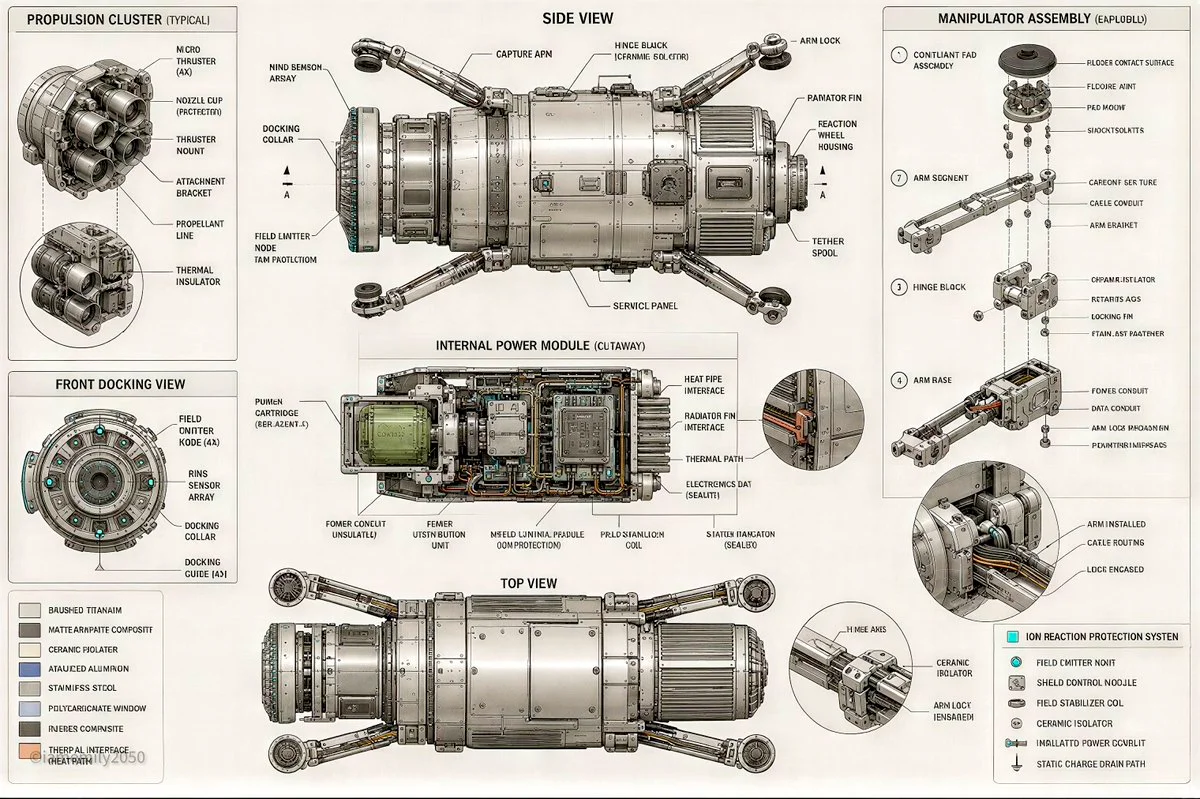
Mechanical blueprint shows ion protection system with labeled assemblies
Orthographic engineering drawing of an ion reaction protection system on a pale grid background, with exploded components, leader lines, and technical labels like CORE MODULE and FIELD EMITTER.
Prompt
Keep exploring the possibilities
GPT Image Gen V2

Create a precision mechanical blueprint sheet for [SUBJECT], designed as an engineering document rather than a product render.

View and sheet structure: orthographic primary view, controlled perspective only in secondary cutaway panels, pale technical grid background, thin construction lines, sectional hatching, exploded components, magnified circular insets, leader lines, material callouts, and assembly order markers. The subject should occupy the main drawing area with secondary modules arranged asymmetrically around it.

Mechanical credibility: every visible part must have a defined function. Show load paths, hinge axes, bearing locations, power routing, sensor placement, cooling channels, access panels, fasteners, seals, brackets, protective housings, and serviceable modules. Do not include decorative parts that have no mechanical support, attachment point, cable path, or structural purpose.

Protection system: represent the ion reaction protection system as an engineered safety mechanism. Use sealed emitter rings, insulated conduits, ceramic heat sinks, vibration isolators, transparent inspection windows, field stabilizer coils, diagnostic lenses, and shield control modules. Keep the illumination limited to small cyan or blue white indicators inside physical housings.

Material language: brushed titanium, bead blasted aluminum, graphite composite, matte ceramic insulation, transparent polycarbonate inspection covers, black rubber seals, anodized connector collars, and exposed stainless fasteners. Use material transitions at plausible joints rather than random surface patches.

Drawing behavior: use crisp vector like linework, clean object silhouettes, accurate proportional relationships, visible cross sections, correct component alignment, consistent scale between modules, and readable separation between the main object and exploded parts.

Text behavior: use short uppercase technical labels only. Use labels such as CORE MODULE, FIELD EMITTER, COOLING CHANNEL, SENSOR ARRAY, POWER BUS, SERVICE PANEL, STRUCTURAL RIB, and MATERIAL CUTAWAY. Avoid fake paragraphs, random serial codes, dense specification tables, unreadable microtext, and invented measurements.

Failure prevention: avoid ornamental science fiction shapes, floating parts outside exploded panels, inconsistent scale, impossible joints, broken cable paths, unsupported armor plates, decorative glow, weapon barrels, flames, smoke, showroom lighting, scenic backgrounds, and centered beauty composition.
Published: June 4, 2026 by Emily