Image Nano Banana Pro
Journey Through Invention: A Maker's Workbench Chronicle
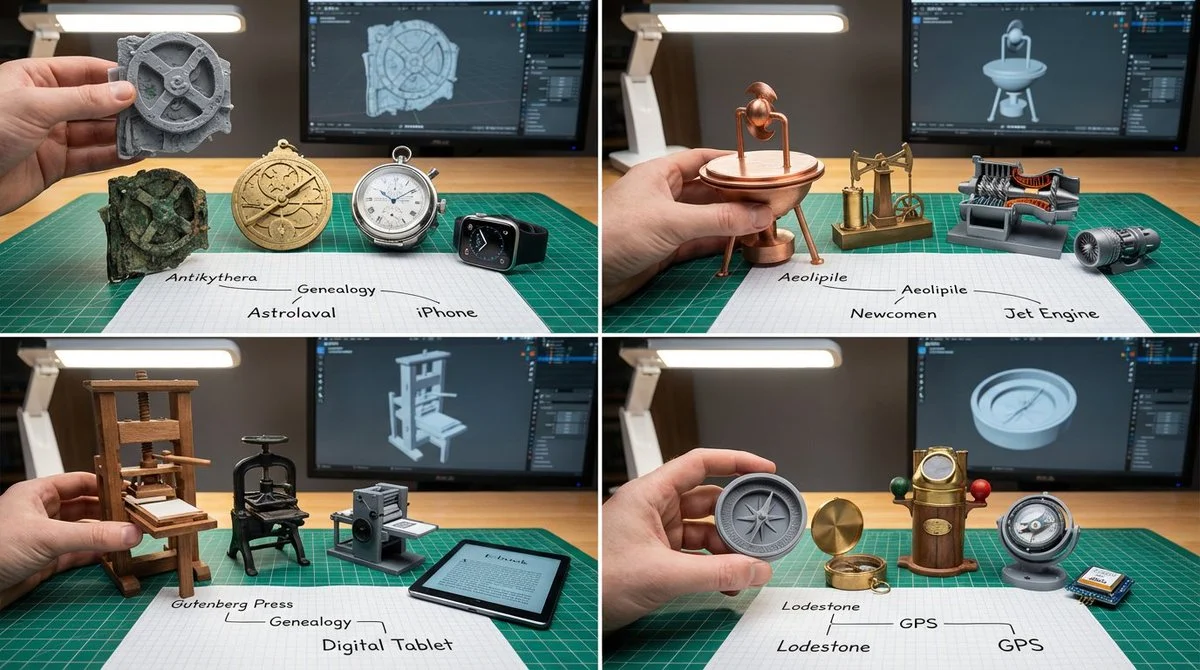
A stunning grid showcases the evolution of technology, from the Antikythera to digital marvels. Explore craftsmanship amidst tools, blueprints, and a 3D printing adventure!
Prompt
Copied. Make it your own here.
Prompt prefilled · Suggested: Nano Banana 2 · 4 credits/image
a 2x2 grid, each panel with a new random historical invention <instructions>
Input Variable:   [input] (e.g., Antikythera Mechanism, The Aeolipile (Steam Engine), The Gutenberg Press)
System Instruction:
Generate a hyper-realistic, macro "Maker's Workbench" showing the evolutionary lineage of an ancient technology.
CRITICAL:   Do NOT invent futuristic items. Show the   Real-World Historical Successors   of the artifact.
Semantic Lineage Analysis:
Analyze the Artifact's Function:   What did it do? (e.g., Antikythera = Analog Computer/Calendar).
The Evolutionary Tree:   Identify 3 distinct successors that exist in real history.
Successor A (Medieval/Renaissance):  Brass/Wood instrument (e.g., The Astrolabe or Orrery).
Successor B (Industrial):  Steel/Gear mechanism (e.g., The Marine Chronometer or Mechanical Watch).
Successor C (Modern):  Silicon/Digital (e.g., A Digital Smartwatch or GPS unit).
Container (The Timeline Bench):
The Surface:   A green self-healing   Cutting Mat   clutterd with tools.
 Arrangement:   A linear or semi-circle arrangement of   4 Physical Models  , moving from Left (Ancient) to Right (Modern).
Also a hand holding an unfinished 3D printed version of the artifact.
 Object Details (The Lineup):
Object 1 (The Input):   A hyper-realistic verison of the  [Input Artifact] The original mechanism. (e.g., The jagged Antikythera rock).
Object 2 (Successor A):    The Mechanical/Industrial refinement.
Object 3 (Successor B):   The Electronic/Analog refinement.
Object 4 (Successor C):    The Digital/Silicon culmination.
The Contextual Clutter (The Research):
The Blueprint:   Underneath the models is a large, hand-drawn   Genealogy Chart   sketched on graph paper, connecting the Antikythera to the iPhone with arrows.
The Screen:   BACKGROUND WORKSPACE:
Computer monitor displaying 3D modeling software (Blender/ZBrush interface visible)
Screen shows wireframe mesh of same object mid-construction
Modeling tools visible: topology lines, vertex count, UV mapping
Color-coded model sections
Lighting & Atmosphere:
Style:   "Adam Savage / Tested" Workshop Photography.
Lighting:   High CRI (Color Rendering Index) LED work lights. Very sharp, revealing dust and texture.
Depth:   Shallow DOF. The front row of models is sharp; the monitor is blurry. 6. BACKGROUND WORKSPACE:
Output:   ONE image, 16:9 Aspect Ratio, Product Photography, Maker Aesthetic, 8k.
Published: January 30, 2026 by @Gdgtify