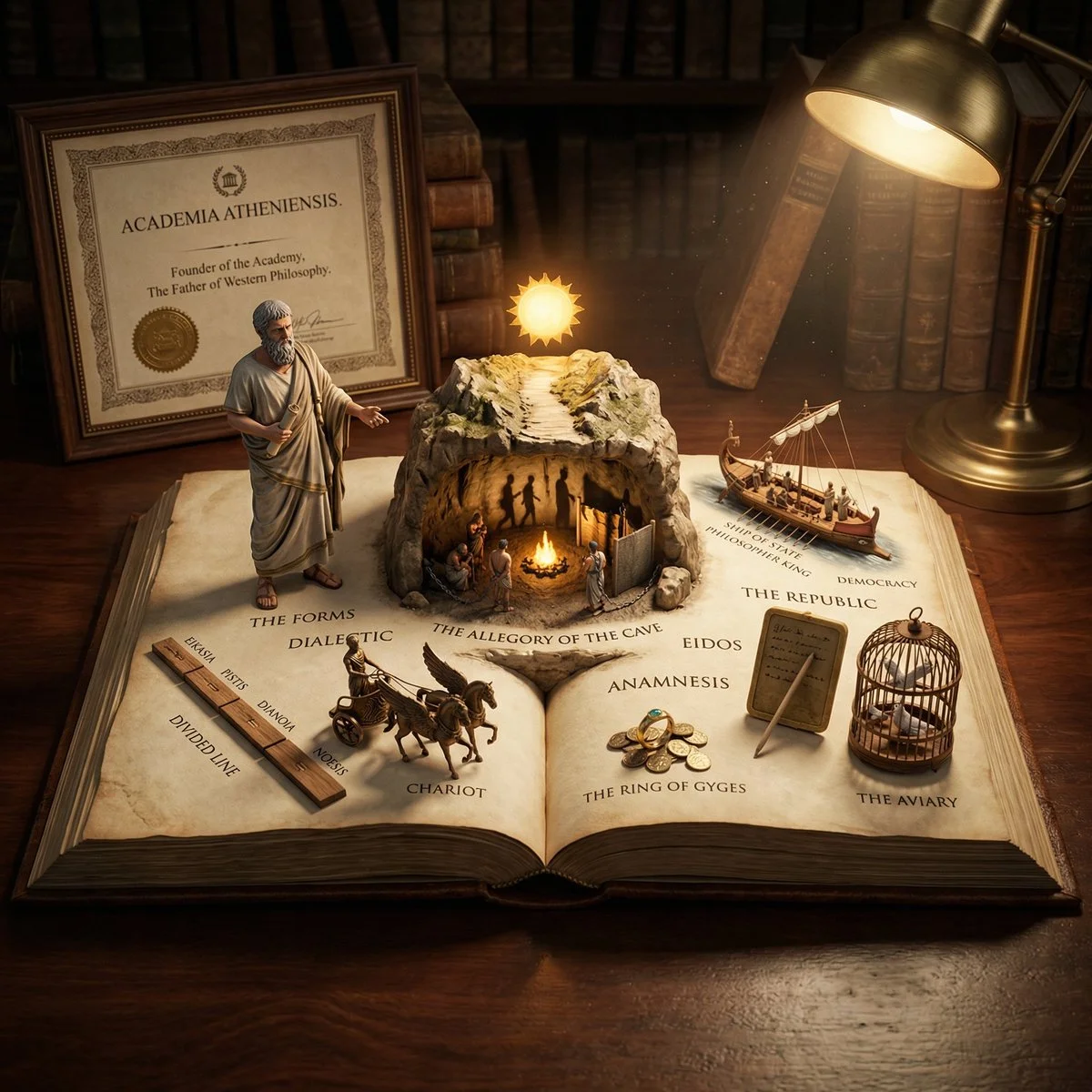
Image Nano Banana Pro
Historical Thinkers Brought to Life in 3D Dioramas
Miniature models of legendary scientists and philosophers interact with their theories in a hyper-realistic diorama, blending ancient wisdom with modern artistry.
Prompt
<instruction>
  1. Inference Engine
Input A is a historically significant Scientist, Philosopher, or Theorist (e.g., Albert Einstein, Isaac Newton, Charles Darwin, Marie Curie).
Deconstruct their life's work into   4 Conceptual Assets  :
     The Core Metaphor (The Centerpiece):  Identify the physical visualization of their most famous theory.
         (e.g., Einstein -> A heavy gold sphere warping a grid. Newton -> An apple falling near a prism. Darwin -> A branching tree of life).
     The Analogies (The Props):  Identify the thought experiments or objects used to explain their ideas. Include at least 6
         (e.g., Einstein -> A moving train and a pocket watch. Newton -> A cannon on a mountain. Schrödinger -> A box).
     The Variables (The Text):  Key equations, terms, or book titles associated with them.
         (e.g., $E=mc^2$, Natural Selection, $F=ma$).
     The Accolade (The Background):  A framed certificate or award acknowledging their ultimate achievement (e.g., Nobel Prize, Royal Society Membership).

  2.   Container (The Academic Journal):
Goal: "The Theory Made Physical" Diorama Photography.
     The Stage:  A massive, antique   Hardcover Book or Ledger   lying open flat on a dark wooden desk.
     The Canvas:  The pages are textured, aged parchment.
     The Setting:  A dimly lit, classical study or library.

  3.  The Pop-Up Physics
      Transformation:  The 2D drawings on the page physically manifest into 3D objects.
         Example:  A drawn grid literally dips into the paper under the weight of a physical 3D brass sphere. A drawn line becomes a real miniature train track.
     The Props:  The "Analogies" (Step 1) are placed on the pages as hyper-realistic miniature objects (e.g., a real antique pocket watch, a bent wooden ruler, a tiny steam train).

  4. The Narrative Scale (The Creator):
     The Figure:  A highly detailed, realistic   1:35 Scale Miniature   of Input A stands directly on the open pages.
     The Interaction:  The figure is gesturing toward the "Core Metaphor" or holding a tiny tool (like calipers or a notebook), acting as the presenter of the diorama.

  5. Visua
     Typography:  Elegant, serif text is printed flat on the pages, labeling the 3D phenomena (e.g., "Time Dilation," "Mass-Energy Equivalence").
     Lighting:    Chiaroscuro Desk Lamp.   A warm, directional beam of light sweeps across the book from one side, casting long, dramatic shadows from the 3D objects onto the flat text. Dust motes are visible in the light beam.

  Output:   ONE image, 16:9 Aspect Ratio, Macro Photography, "Museum of the Mind" aesthetic, High Texture Fidelity.
</instruction>
Published: March 4, 2026 by @Gdgtify