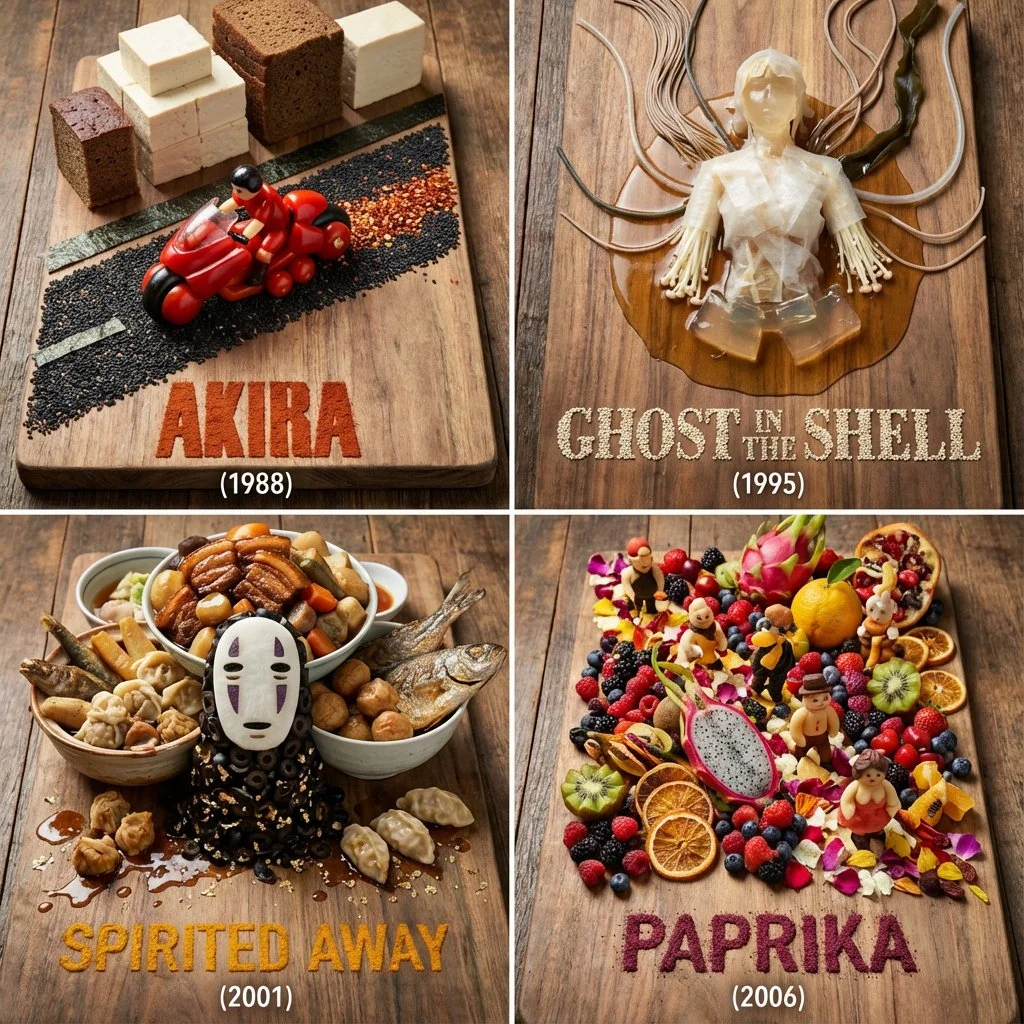
Image Nano Banana Pro
Culinary Cinema: Edible Scenes from Iconic Films
A delectable grid where beloved movie moments transform into mouthwatering, edible art. Each scene bursts with flavors and textures inspired by cult classics!
Prompt
Copied. Make it your own here.
Prompt prefilled · Suggested: Nano Banana 2 · 4 credits/image
Do this for the Bleach  Input Variable:   [INSERT TITLE] (e.g., The Terminator, Dune, The Matrix)

  System Instruction:
Generate a hyper-realistic, 2x2 Grid of "Edible Movie Scenes."

  1.  Archival Analysis:
      Analyze Input:   Identify the Genre, Tone, and Visual Language of the input title.
      The Roster:   Retrieve   4 Lesser-Known / International Cult Classics   that share this genre but have distinct visual styles.
      The Scene:   Identify the defining "Visual Texture" of each film (e.g., is it Rusty? Neon? Organic? Dusty?).

  2.  Inference Protocol :
  CRITICAL:   You are the Chef. You must autonomously select ingredients based on   Visual Biomimicry  .
      The Logic:   "Does this ingredient  look  like that object?"
         Instruction:  Analyze the primary materials in the movie scene (e.g., Metal, Concrete, Flesh, Sand).
         Translation:  Swap these non-edible materials for   Edible Matter   that shares the exact same  Color, Gloss, and Surface Texture.
         Constraint:  Do not use food dye or fondant. Use raw, recognizable organic ingredients (Vegetables, Meats, Grains, Spices).

  3.  Construction  :
      The Subject:   Recreate the iconic scene or character using the selected ingredients.
         (e.g., If the AI sees a rusty robot, it might choose Spiced Beef Jerky or Cinnamon bark—not because I told it to, but because they look like rust).
         (e.g., If the AI sees a slimy alien, it might choose Lychees, Oysters, or Aloe Vera).
      The Terrain:   Build the environment using granular or textural foods (Grains, Flours, Crumbs, Leafs).

  4.   The Setting) :
      The Surface:   A flat-lay surface appropriate to the cuisine style (e.g., Butcher's Block, Slate, Banana Leaf).
      The Garnish:   Micro-details are added using spices or herbs that fit the color palette.

  5. Output Specs:
      Camera:   Top-Down Flat Lay or High-Angle (45 degrees).
      Lighting:   "Gastronomic Magazine" lighting. Sharp, crisp focus to reveal the pores and fibers of the ingredients.
      Render:   8k, Photorealistic, "Food Stylist" aesthetic.  Name and year underneath, name written with relevant spices
Published: January 22, 2026 by @Gdgtify