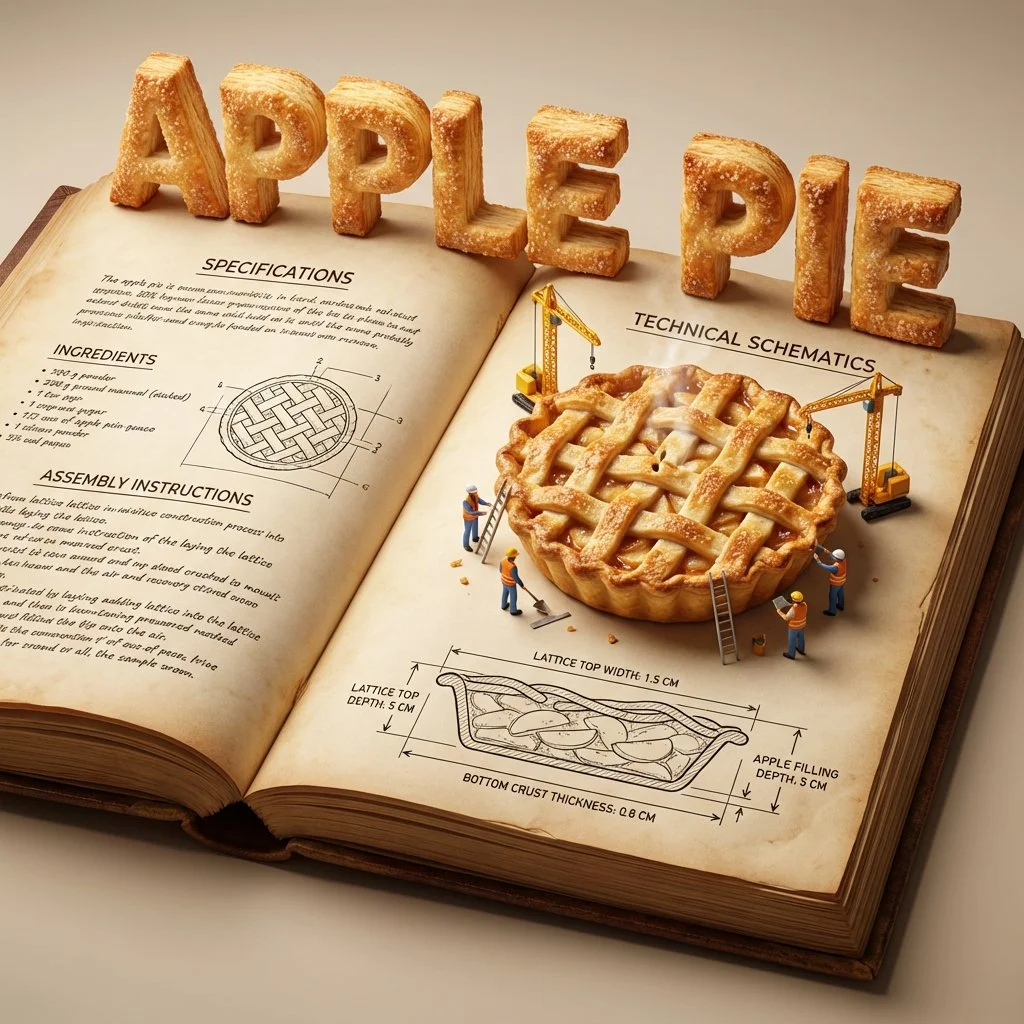
Image Nano Banana Pro
Blueprints of Deliciousness: A Culinary Construction
A captivating fusion of food and architecture, showcasing edible designs and miniature builders. Experience the art of crafting culinary masterpieces!
Prompt
<instruction>
  1. The Edible Blueprint):
Input A is a Dish, Object, or Product (e.g., Apple Pie, Double Cheeseburger, Espresso Machine, Vintage Car).
Analyze the subject to generate   3 Technical Assets  :
      The Material (The Title):   Identify the primary tactile material.
         (e.g., Apple Pie -> Flaky baked pastry. Burger -> Toasted sesame bun. Car -> Polished chrome/paint).
      The Structure (The Schematics):   Identify the internal layers or components for architectural diagrams.
         (e.g., Pie -> Lattice top, apple filling, bottom crust. Burger -> Patty, cheese, lettuce, condiments).
      The Job Site (The Action):   Identify a construction-style task relevant to the assembly.
         (e.g., Pie -> Laying the lattice. Burger -> Stacking the foundation. Car -> Tightening the lug nuts).

  2.  Container (
Goal: "The Blueprint Coming to Life" Tabletop Shot.
     Stage:   A massive, thick antique   Hardcover Book   lying open flat (180 degrees).
      Page:   The paper is heavy, cream-colored, aged parchment with a faint grid or architectural border.
 Layout:   The left side contains "Specifications" (Ingredients/Instructions); the right side contains "Technical Schematics."

  3.  2D Layer
      The Graphics:   The background of the pages features thin, black   Technical Line Drawings   of Input A.
      The Detail:   Include dimension lines with arrows and numeric labels showing height, width, and cross-sections (e.g., a technical wireframe of a burger or the internal engine of a car).

  4.  3D Layer
      The Title:   The name of the subject (Input A) is rendered in massive,   3D Extruded Letters   at the top of the page.
         Rule:  These letters must be made entirely of "The Material" identified in Step 1 (e.g., "APPLE PIE" letters made of baked, golden-brown crust).
      The Realism:   Sitting directly on the page (over the blueprint) is a   Hyper-Realistic 3D Miniature   of the subject.
         Constraint:  This is   NOT   a drawing. It must look like a physical, photorealistic object casting a real shadow on the paper.
      The Crew:   A team of   1:87 Scale Construction Workers   (wearing hard hats and vests) are actively "building" the 3D object using the "Job Site" task from Step 1.

  5. Lighting & Atmosphere:
      Lighting:     Warm Studio Spotlighting.   Even, soft-box light to ensure the 2D text is legible, while creating a distinct 3D pop for the photorealistic model and figures.
      Texture:   High-fidelity focus on the contrast between the flat matte paper and the moist, greasy, or textured surface of the 3D subject.

  Output:   ONE image, 1:1 Aspect Ratio, "Is It Real?" aesthetic, High Information Density.
</instruction>
Published: February 6, 2026 by @Gdgtify