Image Nano Banana Pro
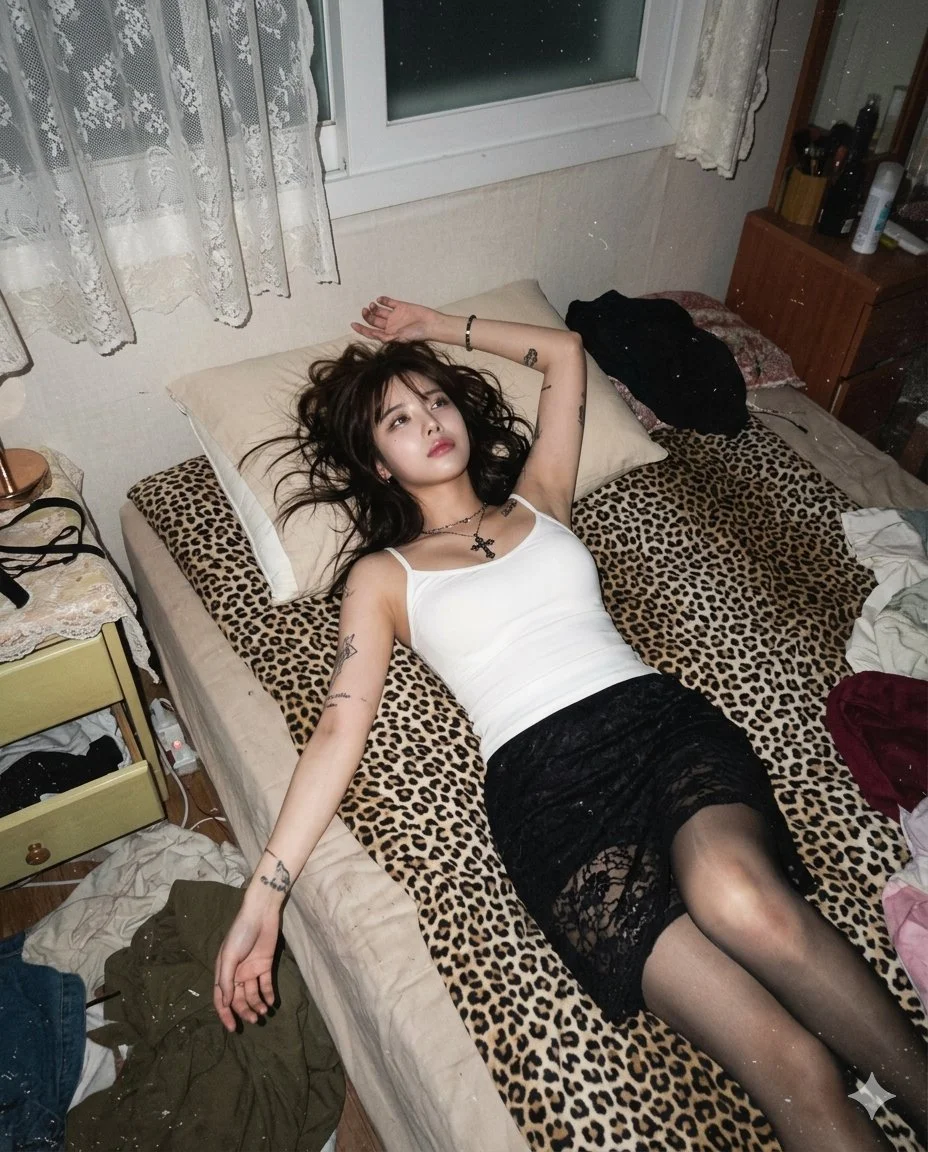
A woman lies lost in thought on a leopard-print bed at night.
A dim, candid bedroom snapshot captures a woman sprawled across leopard-print bedding, her gaze distant and detached. The image is degraded by motion blur, harsh flash, and heavy JPEG artifacts, evoking a forgotten 2000s digital memory.
Prompt
Create image: use the attached image.

A candid late-night bedroom memory captured during an ordinary restless evening. The subject lies diagonally across an unmade bed covered with worn leopard-print bedding. One arm stretches above her head while the other rests loosely beside her body. She gazes blankly toward the ceiling with a distant, emotionally detached expression, as if lost in thought at 2 AM while everyone else is asleep. Messy dark hair spreads unevenly across the pillow and sheets.

She wears a fitted white camisole, a black lace slip skirt, sheer dark stockings, a small gothic cross necklace, and simple jewelry. Tattoos are partially visible on her arms. The room feels personal, well maintained and lived-in rather than aesthetic.

Behind her hangs an old lace curtain covering the window. The room contains mismatched furniture, dark corners, worn fabrics, scattered personal belongings, and ordinary household clutter. Nothing appears intentionally styled. Everything feels naturally accumulated over time.

The photographer was not trying to create a beautiful image. The photograph feels accidental, poorly composed, and taken without preparation. The shutter was pressed unexpectedly while the subject shifted position. The camera angle feels awkward and slightly wrong. The image resembles an old forgotten snapshot found years later in a dusty photo box.

Subject occupies approximately 70–80% of the frame while remaining noticeably off-center. Negative space appears primarily on one side through the dark bedding, lace curtain, and dim room interior. Headroom remains approximately 15–20%. Parts of the bed, pillow, body, furniture, and curtain are awkwardly clipped by the frame edges.

Snapshot captured on a cheap 2000s low-resolution toy digital camera. Heavy motion blur, slight camera shake, crooked framing, accidental composition, harsh direct pop-up flash creating blown highlights and dirty flash falloff, muddy shadows, faded low-fidelity colors, intense digital noise, heavy sensor grain, chromatic aberration, thick plastic toy-lens softness, focus miss, JPEG compression damage, motion smear, and 0.3-megapixel quality.

The toy camera struggles to resolve detail. Facial features remain recognizable but softened by blur, compression, focus failure, and low-resolution sensor limitations. Hair strands merge together. Lace patterns, fabric texture, bedding details, curtain texture, tattoos, and room objects lose definition and become smeared.

The image resembles a forgotten Friendster-era photo repeatedly uploaded, downloaded, and re-saved over many years. Visible JPEG artifacts, scan-like grain, dust specks, scratches, faded print texture, worn image quality, dirty flash reflections, and file degradation affect the entire image.

Do not preserve modern beauty-photo clarity.

Do not protect facial sharpness.

The subject remains recognizable despite image degradation.

The photograph prioritizes memory over aesthetics.

--ar 4:5

Negative prompt:
beauty filter, modern smartphone quality, DSLR quality, cinematic grading, HDR photography, professional composition, centered composition, balanced framing, excessive top headroom, excessive bottom empty space, studio lighting, ultra sharp face, perfect skin, flawless focus, fashion editorial, influencer photo, polished digital rendering, AI perfection, hyper-detailed eyes, premium camera quality, luxury portrait photography, clean digital photo
Published: June 19, 2026 by Chryz leen