Image Nano Banana Pro
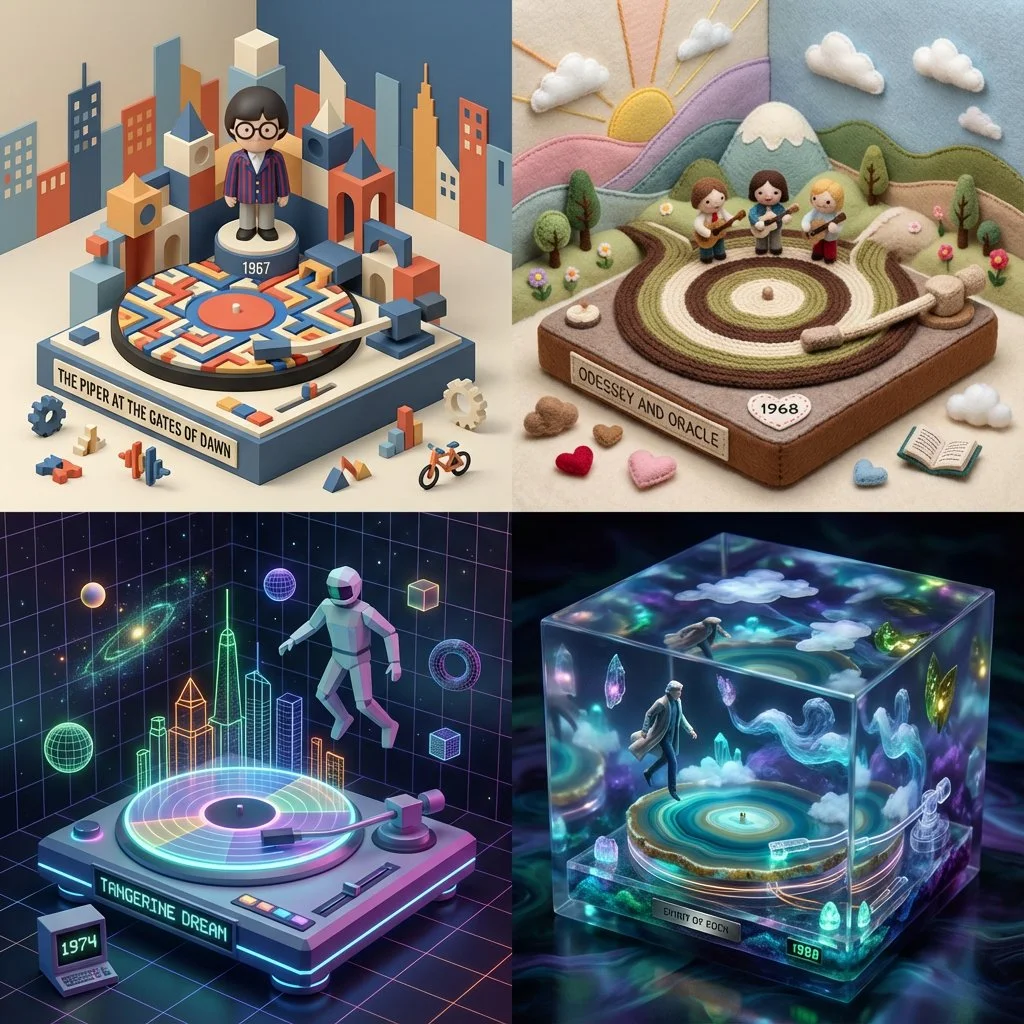
A Sonic Mosaic: Four Hidden Gems Inspired by Pink Floyd
Explore a vibrant 2x2 grid showcasing lesser-known album styles, each panel bursting with unique artistry that captures the essence of Pink Floyd's spirit.
Prompt
Copied. Make it your own here.
Prompt prefilled · Suggested: Nano Banana 2 · 4 credits/image
Do this for Pink Floyd:

<instructions>  Input: A seminal music album (cover or name). Instruction: Act as a world-class music expert and visual engineer. For the uploaded album, find 4 much lesser-known "hidden gem" artist in the same genre or spirit. Create a 2x2 image grid. Each panel in the grid must visualize each hidden gem's album using one of the four distinct styles below. The album title must be subtly integrated as a physical label or display within each panel. Panel 1: Mod Designer Toy Style (for Hidden Gem 1) Analyze: The album's energy, architectural sounds, and rhythmic precision. Action: A stylized, angular turntable with a record that has a raised, geometric pattern. Visual: The record's pattern extrudes into a modular, architectural landscape. A blocky, minimalist figurine of the artist, with exaggerated iconic features, stands on a platform base within this landscape. Rules: The diorama backdrop is a flat, graphic cityscape or geometric pattern in matte colors. 5-7 miniature props are clean, angular 3D abstractions of song rhythms or lyrical concepts. The album's release year is screen-printed on the figurine's base. Output: A single panel in the 2x2 grid. Clean, collectible, and graphic. Panel 2: Yarn & Felt Art Style (for Hidden Gem 2) Analyze: The album's raw emotion, acoustic textures, and intimate, homespun feel. Action: A crocheted circular rug representing a record, on a felt turntable. Visual: The yarn "grooves" of the rug become a soft, hilly landscape of felt and batting. A small, wool-felt doll of the artist, with simple stitched details, is positioned in the scene. Rules: The backdrop is a layered felt wall with embroidered details. 8-10 props are small, sewn or pom-pom representations of key emotional objects or natural elements from the lyrics. The release year is cross-stitched on a tiny patch. Output: A single panel in the 2x2 grid. Textured, warm, and handcrafted. Panel 3: Retro Futurist 3D CGI Style (for Hidden Gem 3) Analyze: The album's synthetic sounds, themes of technology, and vintage futuristic atmosphere. Action: A low-poly 3D model of a turntable, its spinning record a glowing, segmented disc. Visual: Data rises from the disc like a wireframe city or digital nebula. A simplified, faceted 3D model of the artist, reminiscent of 80s CGI, is integrated into this digital landscape. Rules: The backdrop is a deep grid or starfield. Props are primitive 3D shapes (spheres, cubes, toruses) representing digital concepts or song titles, floating with subtle glow. The release year is displayed on a tiny, pixel-font CRT monitor. Output: A single panel in the 2x2 grid. Digitally nostalgic, sleek, and cool. Panel 4: Glowing Epoxy Resin Diorama (for Hidden Gem 4) Analyze: The album's ethereal moods, layered sounds, and dreamlike or psychedelic qualities. Action: A record player cast in clear resin, with the record itself being a slice of agate or luminous material. Visual: Swirls and objects within the resin "record" expand to form the diorama's environment—clouds, waves, or abstract forms. A finely detailed, miniature artist figure is suspended as if walking through this frozen scene. Rules: The entire scene is a single resin block. Props (crystals, tiny leaves, abstract shapes) are embedded, some with internal LED-like glows. The album title is etched on a tiny metallic plate submerged in the resin. The release year is on a minuscule, glowing digital readout. Output: A single panel in the 2x2 grid. Mysterious, luminous, and encapsulating. Final Output: ONE cohesive 2x2 grid image. Each panel is a distinct world, unified by the theme of musical discovery and deep-diorama craftsmanship.
Published: January 21, 2026 by @Gdgtify