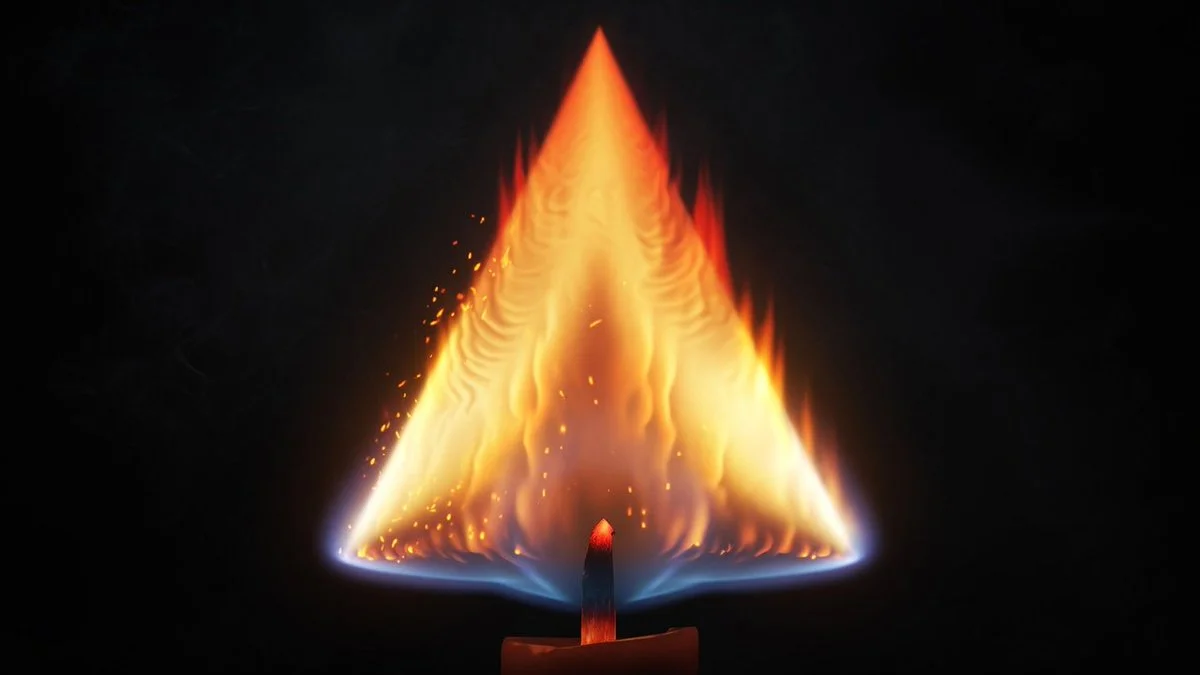
Image Grok Imagine
The Triangle That Became a Flame
Trace the journey of the upward-pointing triangle from classical elemental fire symbolism to its role as Δ in chemistry, marking heat applied in reactions.
Prompt
The **Δ** (uppercase delta) symbol is commonly used in **chemistry** to indicate that **heat** (or flame/ignition) is applied to a reaction—placed above or below the reaction arrow, like this:
**A + B →** **Δ** **C + D** (meaning "heat is added").

### Why does it represent flame/heat?
It stems from **alchemy** and classical elemental symbolism, not the Greek letter's original meaning ("delta" just means the triangular shape, from the Phoenician letter for "door").

- In ancient and medieval **alchemy**, the four classical elements had simple geometric symbols:
  - **Fire** was represented by an **upward-pointing triangle** (△ or Δ). This was because fire, heat, and flames rise upward (the "matter of heat" or ascending force).
  - Water was the opposite: a downward-pointing triangle (∇).
  - Air and earth had variations with lines through them.

This system influenced early chemistry. When chemists needed a quick shorthand for "apply heat" in reaction schemes (back when lab heating often came from candles or Bunsen burners, whose flames are roughly triangular), they borrowed the **alchemical fire symbol**—the upright triangle.

Over time, as typewriters and computers standardized symbols, this triangle became identified with the **Greek capital delta (Δ)**, which looks identical. So today, people casually call it "delta" even though its use for heat/flame is really the old fire triangle in disguise. Some older texts or purists still point out: "It's not really a delta—it's the alchemical symbol for fire."

### Practical notes
- It specifically means **thermal energy** is supplied (heating the mixture, often to reflux or drive the reaction).
- It does **not** mean "change" in this context (that's a separate use of Δ, like ΔH for enthalpy change).
- In some very old lab notes, you might even see a small isosceles triangle drawn under the arrow to mimic a literal flame shape before it standardized to the equilateral Δ.

In short: the association with **flame** comes from fire's ancient triangular emblem, which evolved into the modern chemistry shorthand for heating. It's a cool bit of historical continuity between alchemy and modern science.
Published: April 15, 2026 by alby13