Image Nano Banana Pro
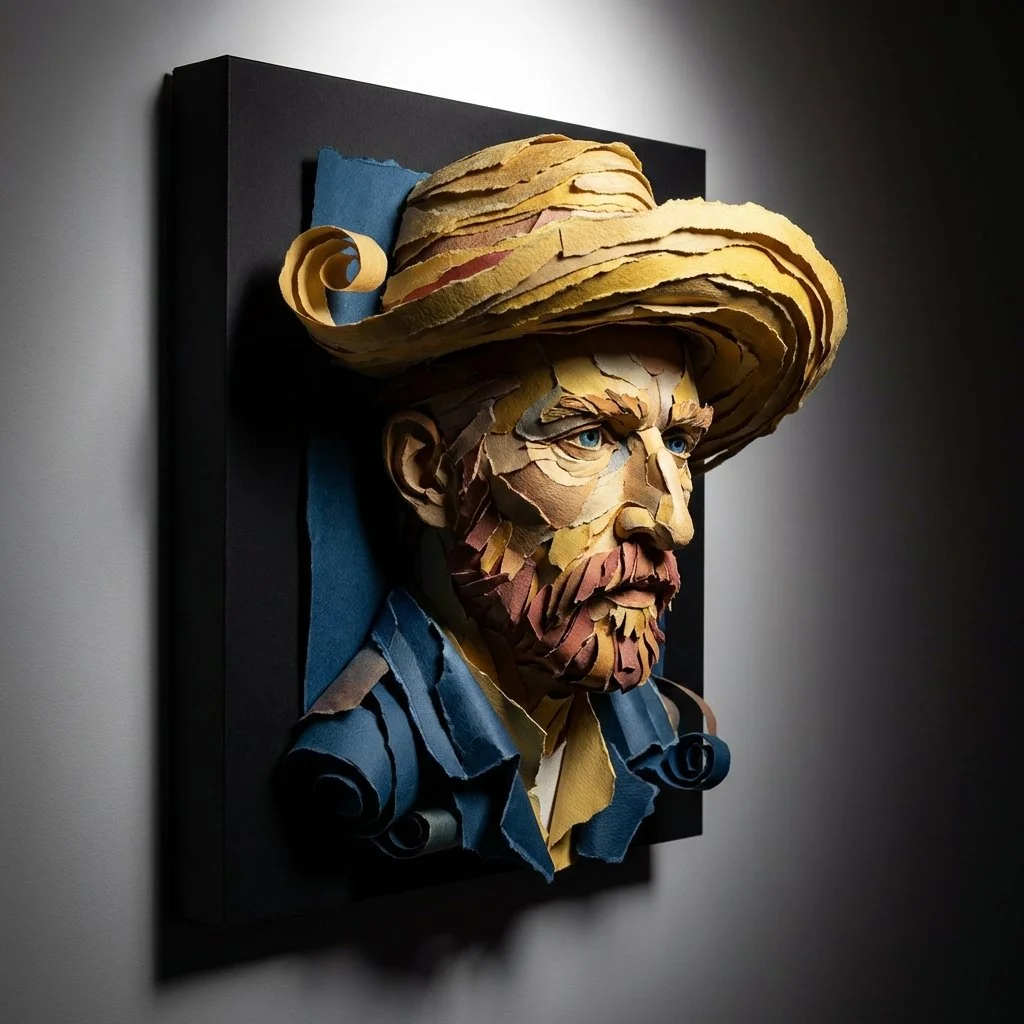
A Papercrafted Genius: Einstein in 3D Layers
This stunning 3D sculpture uses torn paper to recreate Albert Einstein’s iconic features, from his wild hair to his thoughtful expression, all on a matte black frame. A tactile, intricate folk art tribute.
Prompt
Another prompt for visualizing famous people.

<instruction>
  1.  Inference Engine
Input A is a Famous Historical Figure, Artist, or Cultural Icon (e.g., Vincent van Gogh, Abraham Lincoln, Frida Kahlo, Albert Einstein).
Analyze their most recognizable portrait or physical appearance to generate   3 Crafting Assets  :
     The Palette (The Paper Stock):  Identify the 4-5 dominant colors associated with their most famous image or artwork.
         (e.g., Van Gogh -> Mustard yellow, deep blue, ochre, flesh tones. Lincoln -> Black, white, sepia. Kahlo -> Vibrant red, green, black).
     The Form (The Features):  Identify their defining physical characteristics (e.g., Van Gogh's beard and straw hat, Lincoln's cheekbones, Kahlo's unibrow and flowers).
     The Texture (The Tear):  Determine the "stroke" style of the paper.
         (e.g., Van Gogh -> Short, jagged tears mimicking thick brushstrokes. Einstein -> Wild, curled paper strips for hair. Kahlo -> Smooth, layered cutouts).

  2.  Container
Goal: "3D Paper Tole" or "Quilling" Sculpture Photography.
     The Setting:  A clean, minimalist gallery wall (light grey or soft white).
     The Base:  A thick, solid   Matte Black Wooden Canvas or Shadow Box Frame   hanging flat against the wall. The sculpture is built outward from this black void.

  3. The Sculpture (The Topographic Portrait):
     The Medium:  The entire portrait is constructed  exclusively  from hundreds of overlapping, torn, and cut pieces of   Thick, Colored Construction Paper or Cardstock  .
     The Dimensions:  This is a   High-Relief 3D Sculpture  . The paper pieces are stacked deep, projecting significantly off the black canvas toward the viewer.
     The Construction:
        Skin and facial features are built like a topographical map, with torn edges creating the contours of the cheekbones and nose.
        Clothing and hair feature rolled, curled, or heavily layered paper strips to create dynamic volume (e.g., a hat brim curling forward, a collar popping out).
     No Paint:  There is no drawing, shading, or painting on the paper. All details and colors come purely from the physical arrangement of the colored paper scraps.

  4. Visual Syntax (The Angle & The Edge):
     The Perspective:  The camera captures the sculpture from an   Oblique or 3/4 Angle  . This is critical to emphasize how far the paper layers project off the black canvas.
     The Edges:  The rough, torn, fibrous edges of the paper scraps must be clearly visible, proving the materiality of the medium.

  5. Lighting & Atmosphere:
     Lighting:    Harsh, Directional Gallery Lighting.   A strong spotlight from the top-left or top-right casts deep, crisp drop-shadows across the layered paper, defining the 3D topography of the face and casting a heavy shadow from the black frame onto the gallery wall.
     Vibe:  Tactile, artisanal, and hyper-detailed "Folk Art" museum piece.

  Output:   ONE image, 1:1 Aspect Ratio, Macro Photography of Papercraft, "Torn Paper Collage" aesthetic, High Texture Fidelity.
</instruction>
Published: April 16, 2026 by Gadgetify